




Soil Insights
Seasonal Primers
What 5 Inches of Rain Really Does to Your Crop — and How to Respond
Heavy rain strips oxygen from the root zone, disrupts nutrient uptake, increases nitrogen losses, and leaves crops vulnerable just as demand begins to climb. Here’s what happens underground—and how to respond.

Table of Contents
- What Happens Underground After 5 Inches of Rain?
- Oxygen depletion — the bigger insult
- Leaching — mobile nutrients flushed through the profile
- The day-by-day timeline: what you'll see in the field
- Why foliar feeding works
- The honest limits — where foliar applications disappoint
- Let's talk Humic
- Be ready before the next big rain
- The bottom line
 What Happens Underground After 5 Inches of Rain?
Table of Contents
- What Happens Underground After 5 Inches of Rain?
- Oxygen depletion — the bigger insult
- Leaching — mobile nutrients flushed through the profile
- The day-by-day timeline: what you'll see in the field
- Why foliar feeding works
- The honest limits — where foliar applications disappoint
- Let's talk Humic
- Be ready before the next big rain
- The bottom line
We finally got the rain.
Across much of Southern Alberta, growers saw anywhere from 3–7 inches of moisture over just a few days, with reports of up to 80 mm in areas such as Mossleigh, Vulcan, and Nobelford. For many dryland growers, it was exactly what the crop needed.
At least at first glance.
From the road, most fields still look reasonably good. Maybe there are a few waterlogged headlands, some standing water in the low spots, but nothing that immediately raises alarm.
Underground, however, it's a different story.
After 5 inches or more of rain, the soil environment changes rapidly. Oxygen disappears from the root zone. Nitrogen starts leaving the system. Root activity slows. Nutrients begin moving beyond the reach of the crop just as demand starts to increase.
In other words, some of the fertilizer you paid for is no longer where the plant can easily access it.
The challenge isn't always what was lost. Often, it's that the crop temporarily loses its ability to take up what remains.
This is where foliar nutrition can become one of the most valuable tools in the toolbox.
Used properly, a well-timed foliar application can help bridge the gap while roots recover and nutrient uptake returns. Used poorly, it becomes an expensive pass that reinforces the belief that foliar feeding doesn't work.
So before the sprayer rolls, it's worth understanding what actually happens after a major rain event, which nutrients are most vulnerable, where foliar nutrition fits into a recovery strategy, where its limitations are, and how humic and fulvic acids can support nutrient efficiency alongside UAN applications through the pivot or sprayer.
What Happens Underground After 5 Inches of Rain?
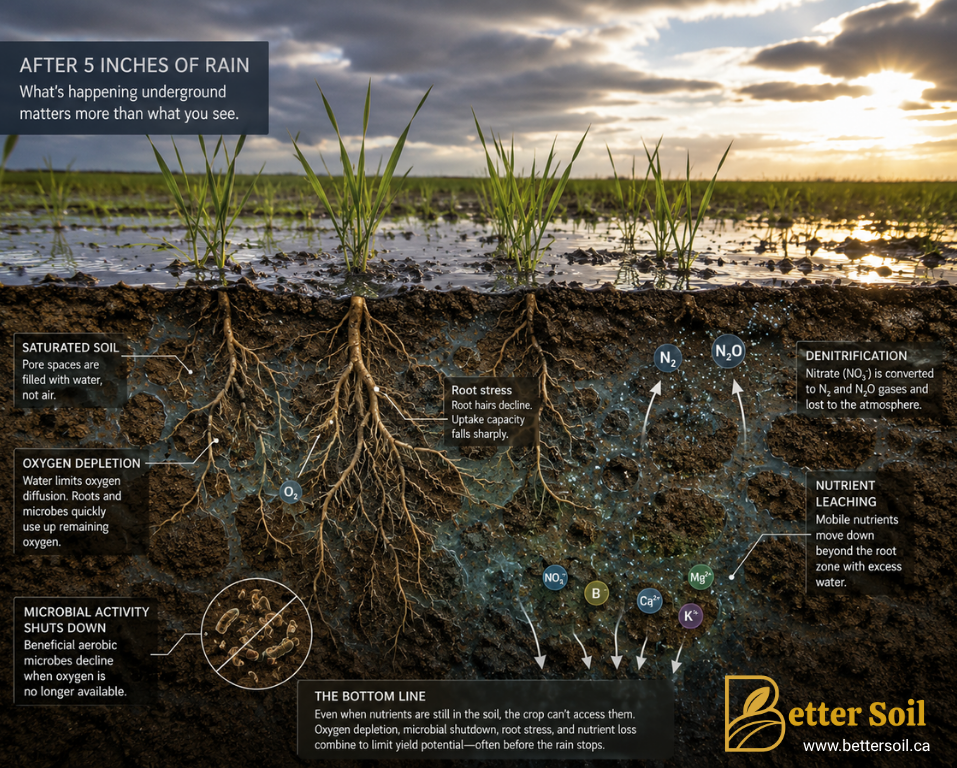
Most growers think of heavy rain as a leaching event.
And it is.
But on many of Southern Alberta's clay and loam soils, leaching isn't the first problem.
Oxygen is.
Long before nutrients begin moving out of the root zone, the soil's air-filled pore spaces fill with water. Roots, microbes, and nutrient cycling all depend on oxygen, and once it disappears, the entire system starts to change.
Two things begin happening underground at the same time:
- Root function and biological activity start shutting down due to oxygen depletion.
- Mobile nutrients begin moving deeper into the profile or leaving the system altogether.
Both matter.
But on heavier soils, oxygen depletion is often the bigger insult.
Oxygen depletion — the bigger insult
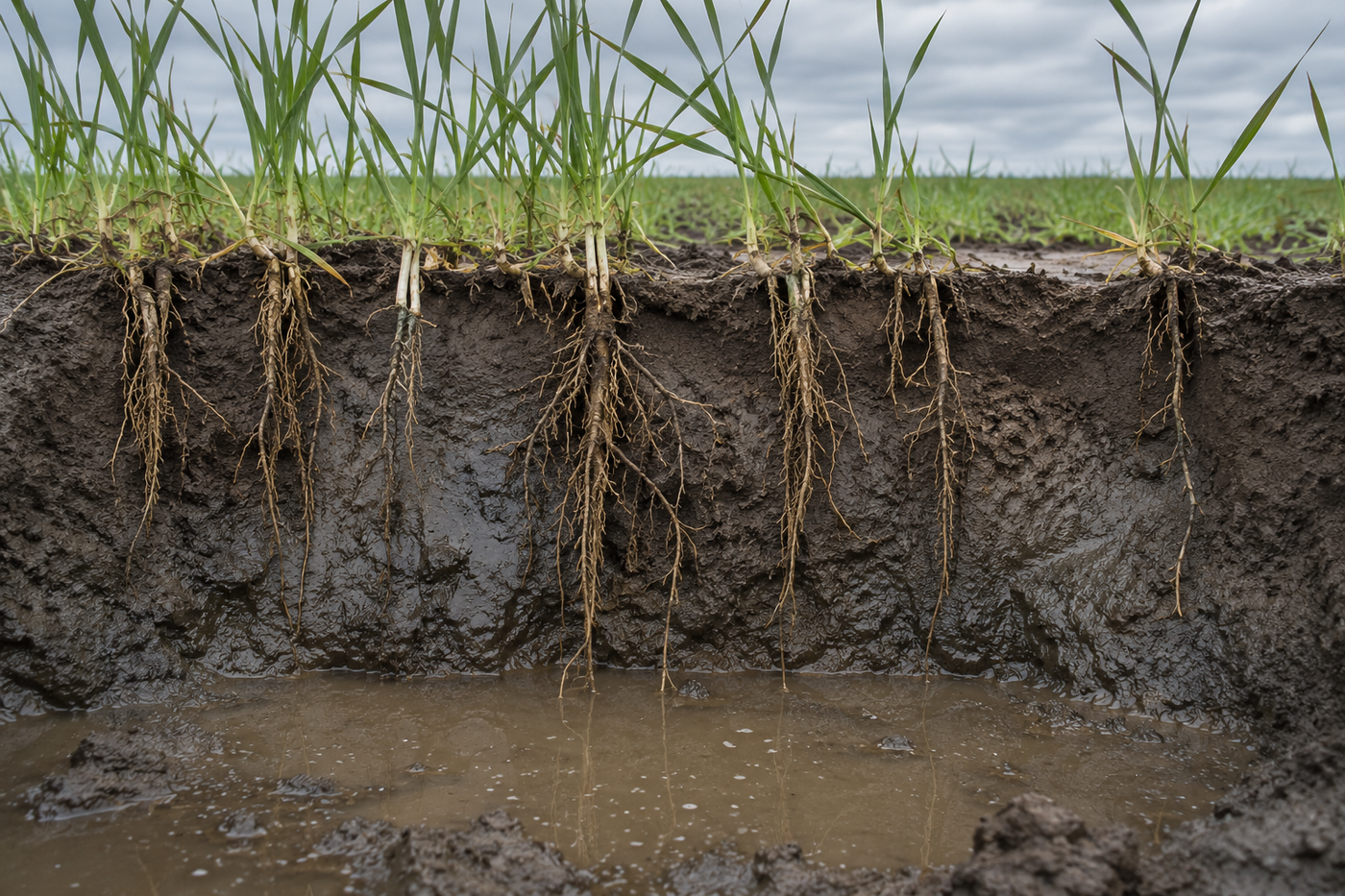
Soil is roughly half pore space, and under normal conditions that pore space is split between air and water. After 3 days of steady rain and 5-7 inches of moisture, those pores are full of water and nothing else. Oxygen diffuses through water roughly 10,000 times slower than through air, so the moment a soil saturates, gas exchange with the atmosphere effectively shuts off. The oxygen still in the soil at the start of the storm is consumed by roots and aerobic microbes within hours, and once it's gone, the whole soil chemistry flips.
What happens next is a predictable sequence driven by redox chemistry — soil microbes start using whatever electron acceptor is next in line:
- Nitrate goes first. Denitrifying bacteria switch on and start respiring nitrate, converting your NO₃⁻ to N₂ and N₂O gas that disappears into the atmosphere. On warm saturated soils this can run at 2-5 lb of N per acre per day. Three days of waterlogging on warm ground can easily torch 10-15 lb of available N before a single drop has leached anywhere.
- Then manganese, then iron. Mn⁴⁺ and Fe³⁺ get reduced to their more soluble forms — sometimes useful, sometimes toxic, and always an indicator that the soil chemistry has gone where you don't want it.
- In severe cases, sulfate. With extended saturation you start seeing sulfate reduction to hydrogen sulfide — the rotten-egg smell coming off a really compromised soil.
While all of that is going on in the soil, your roots are sitting in the same anaerobic environment. Root cells are not adapted to anaerobic respiration for long — they switch from efficient aerobic metabolism to inefficient fermentation, ATP production crashes, and active nutrient uptake (which costs energy) falls off a cliff. Root hairs start dying within a few days. Mycorrhizal associations, which need oxygen to function, stall out. The plant doesn't just lose access to what got denitrified or leached — it loses much of its ability to take up what's still there.
That's the part that surprises growers. You can have a soil test that still shows reasonable nutrient levels and a crop that is functionally starving, because the plant has lost its delivery system.
A crop can be standing in moisture and still be starving.
Leaching — mobile nutrients flushed through the profile
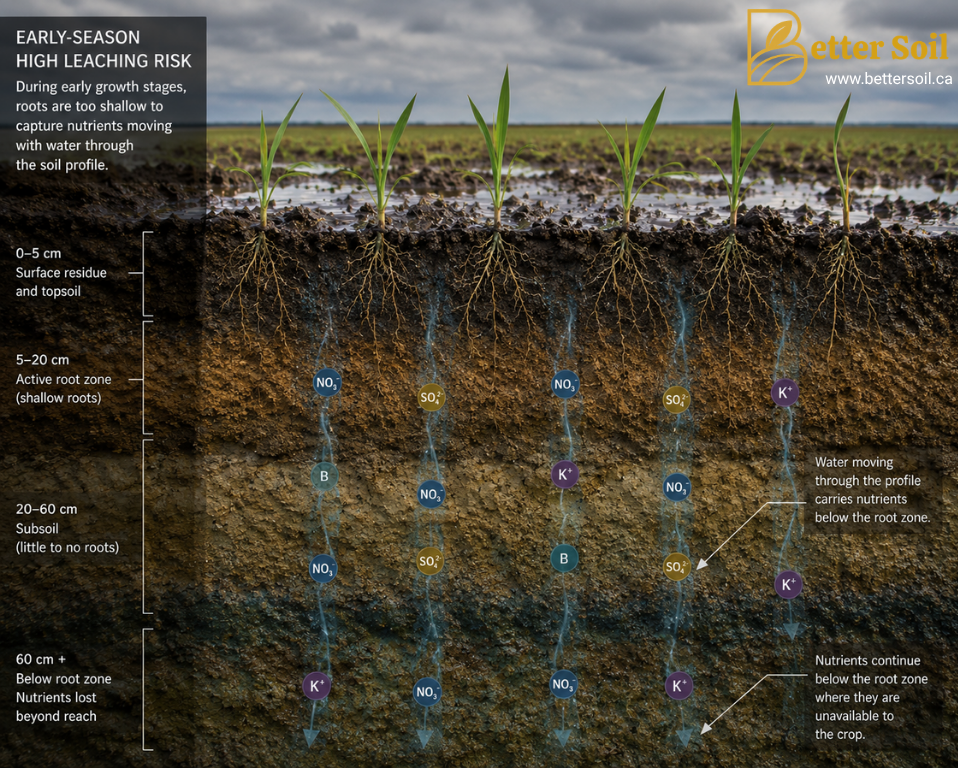
The leaching side of the equation is the one most growers think of first, and it's real. Not all nutrients leave the same way or at the same speed. Nitrate nitrogen is the runner of the group — because it carries a negative charge, soil colloids won't hold it, so it moves with the water, and when water moves down past the root zone, the nitrate goes with it. Sulfate behaves the same way, boron and some potassium move with the flow, and calcium and magnesium are vulnerable under poor-quality water.
The numbers from the leaching literature are sobering. In Sitthaphanit and colleagues' (2009) work on sandy soils under high-rainfall, the recommended single basal fertilizer treatment lost roughly 28 kg N/ha — about a third of the basal nitrogen applied — straight down a soil column under simulated heavy rain. Phosphorus losses ran around 36% of what was applied at sowing in the same system. These observations were taken on sandy tropical soils, so they don't transplant the exact figures onto calcareous clay's like those across parts of Southern Alberta — but the principal travels everywhere: the more mobile the nutrient and the more water moving through the profile, the more you will lose!
Three findings from that body of work matter for timing decisions:
The greatest leaching risk is early, when roots are small. Their data showed nitrate moving deep in the first couple of weeks after emergence, when root density was still low and there was nothing down there to catch it. The same heavy rain later in the season — after the crop had built a dense, deep root system and was drying the profile through transpiration — caused almost no loss, even when more fertilizer had just been applied. Once the crop is actively pulling water and there's no deep drainage, there's very little leaching.
Splitting and delaying fertilizer application during the earlier stages of development proved better. Synchronizing supply with crop demand turned a leaching problem into a yield gain in their fields — maize went from 1.3 to 1.8 tonnes/ac simply by matching nutrient availability to the period of high uptake instead of front-loading it.
It isn't just nitrogen. Phosphorus leaches in low-sorption sandy soils, potassium leaches where clay is low, and the same review flags sulfur, boron, calcium, and magnesium as vulnerable under poor-quality water or intense rain. After a saturating event you can be looking at a multi-nutrient setback, not just an N problem.
The day-by-day timeline: what you'll see in the field
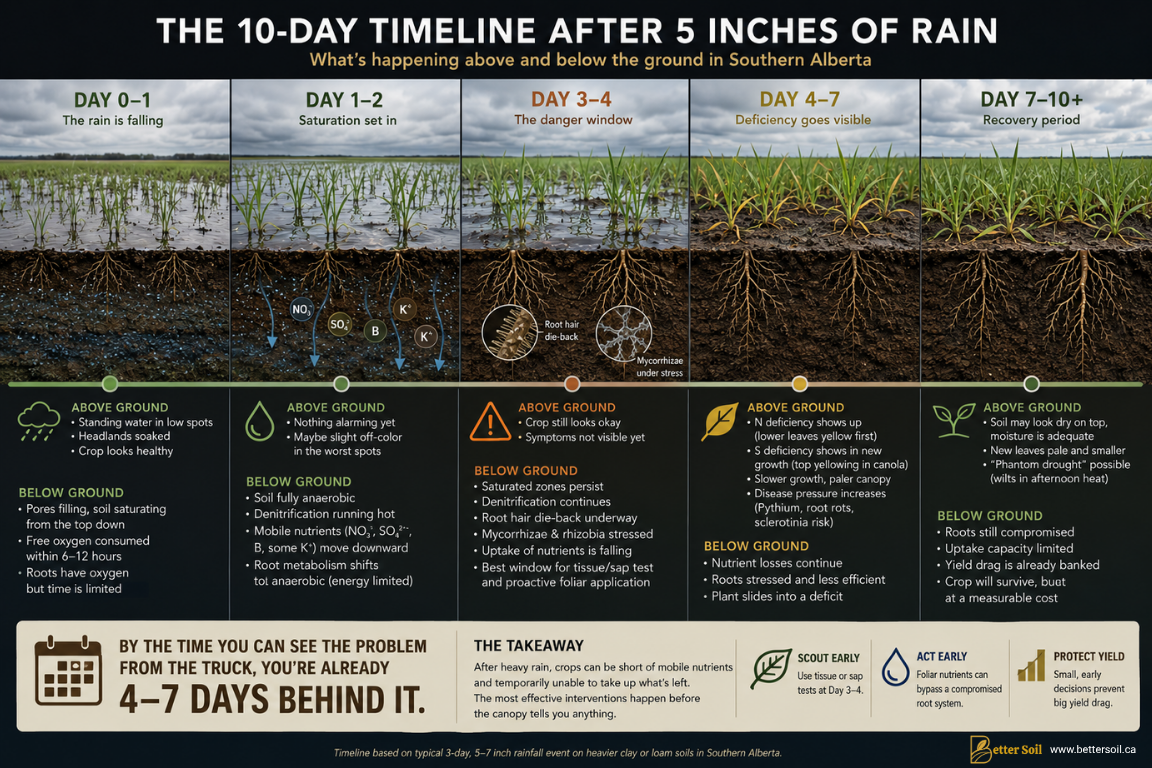
For a typical 3-day, 5–7-inch event on heavier Southern Alberta clay or loam, here's roughly how it plays out above and below the ground.
Day 0-1 (the rain is falling):
Pores filling, soil saturating from the top down. The free oxygen in the soil air is consumed within 6-12 hours. Visibly: standing water in the low spots, headlands look soaked. The crop looks fine.
Day 1-2 (saturation set in):
Soil is fully anaerobic in the affected zones. Denitrification is running hot. Mobile nutrients (nitrate, sulfate, boron, some K) are migrating downward with the percolating water. Root metabolism has shifted to anaerobic, and the plant is running on fumes. Visibly: nothing alarming yet for most growers — maybe the worst spots are looking slightly off-color, but it's easy to miss.
Day 3-4 (just after the rain stops):
This is the danger window. Saturated zones haven't drained, denitrification is still going, root hair die-back is underway, mycorrhizae and rhizobia (if you're in legumes) are stressed and not delivering. The crop is sliding into a deficit, but the symptoms haven't loudly announced themselves on the canopy yet. This is the best window for a proactive tissue or sap test — you'll catch the deficiency before it shows up on the leaves, which means you can treat it before it becomes a yield drag.
Day 4-7 (deficiency goes visible):
On heavier clay and loam soils, this is when N deficiency starts showing up in the canopy. Lower leaves yellow first, working up — the classic bottom-up chlorosis in cereals and corn, a paler-than-it-should-be canola, a slower-than-it-should-be alfalfa stand. Sulfur deficiency can show up at the top of the canopy in canola (newer growth yellowing — opposite pattern to N, since S is less mobile inside the plant). Disease pressure starts climbing — Pythium, root rots, and the early setup for sclerotinia later in canola. If you're seeing colour change at day 4-7, the soil has been compromised since day 1.
Day 7-10+ (recovery period):
Even after the soil drains back to field capacity, the crop's root system is still compromised, and demand from new growth is climbing. This is when the "phantom drought" can appear — soil moisture is fine but the roots can't deliver, so the crop wilts in the afternoon heat as if it were dry. New leaves come in pale and small. Yield drag is being banked even if the crop survives the season — and it will, but at a cost you can measure in the bin.
The takeaway: By the time you can see the problem from the truck, you're already 4-7 days behind it. The window for the most useful intervention is earlier, before the canopy tells you anything. A foliar review by Niu et al. (2020) makes the underlying point clearly — root nutrient supply gets restricted under abiotic stress, including waterlogging-adjacent conditions, high pH, and salinity, precisely when the soil pathway you've been relying on is least dependable. After a heavy rain you can have a crop that is simultaneously short of mobile nutrients and temporarily unable to take up what's left through its roots. That is the foliar window.
Why foliar feeding works
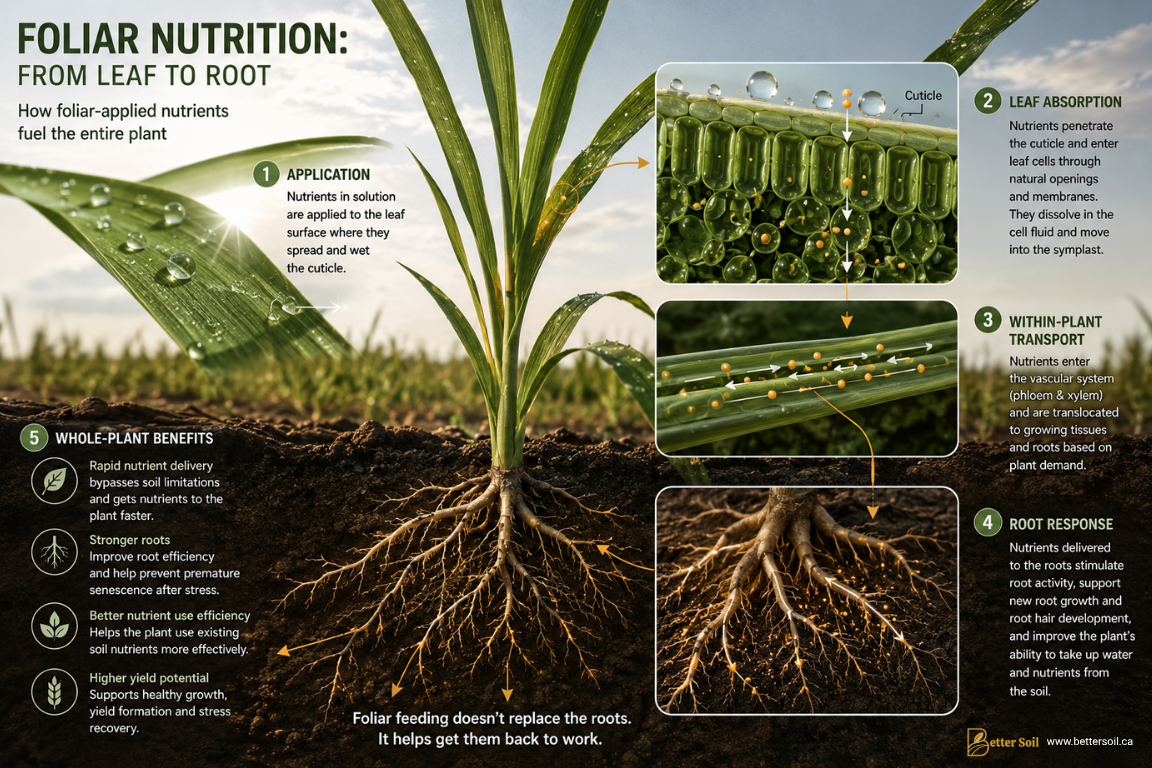
Foliar fertilization works because a leaf is not just a solar panel — it's an absorptive surface. The Niu et al. (2020) review lays out three mechanisms worth knowing:
First, nutrients sprayed on the leaf are absorbed directly and moved to where the plant needs them, refilling the tank faster than the root-and-soil route mechanism. Studies show foliar-applied nitrogen and micronutrients reaching grain/seed (helping fruit fill) at a higher rate of efficiency, unlike the typical soil route — foliar zinc and selenium recovery, for instance, ran many times higher than soil application in the studies reviewed.
Second, you can hit the right nutrient at the right growth stage and the right concentration, instead of hoping the soil delivers on the crop's schedule. After a rain event that's exactly the problem you're solving — the soil's timing is off, so you take the timing back.
Third — and this is the part most miss — foliar feeding doesn't just bypass the roots; it can rescue them. Research from around the world has shown that leaf-applied nutrients move back down through the plant, improve root activity, and help prevent the premature root senescence that stress events trigger. You're not only feeding the canopy; you're helping the root system get back to work.
The strongest evidence in the research though, is for combination, not replacement. Across crop after crop — zinc in rice and wheat grain, nitrogen in cotton under salinity stress, nitrogen-plus-zinc in tree fruit, Potassium and Boron applied to Canola prior to flowering and yet, a soil-plus-foliar beat either approach used alone.
One mechanism behind this is striking. Research conducted on cotton showed a foliar pass increased the root uptake efficiency of soil-applied nitrogen by approx. 28% compared to water alone. The foliar feed primed the plant to use the fertilizer still in the ground more efficiently.
A targeted foliar pass delivers immediate nutrition through the leaf, supports recovering roots, and improves how efficiently the crop mines whatever fertilizer is still in the profile.
The honest limits — where foliar applications disappoint
Foliar isn't magic or a silver-bullet. A single foliar pass can't refill a bulk-N deficit — but a system can shrink how much bulk N you need.
Whether you use a heavy salt-based application or a product with little salt, both will have a ceiling: load the leaf too hard and you cook it. But that ceiling is about the single pass, not the strategy. Spread the load across multiple light, well-timed applications guided by regular tissue or sap testing, and you can feed a far larger share of the crop's nitrogen (and other nutrients) through the leaf than the "corrective only" rule of thumb suggests. Layer in active soil biology — which mineralizes organic N and, through mycorrhizae and the rhizophagy cycle, lets the crop mine nutrients it otherwise couldn't reach — and the newer high-efficiency, fine-particle nitrogen formulations that penetrate at very low rates, and the picture changes.
Growers across the country running these systems have reported a significant reduction in applied granular N (and other nutrients) while still maintaining yield. In short, a foliar pass after a rain still buys you time and efficiency in the moment, but over a season, it is the combination of spoon-feeding, biology, and better-efficiency products that can genuinely lower the bank balance you need to start with — not just borrow against it.
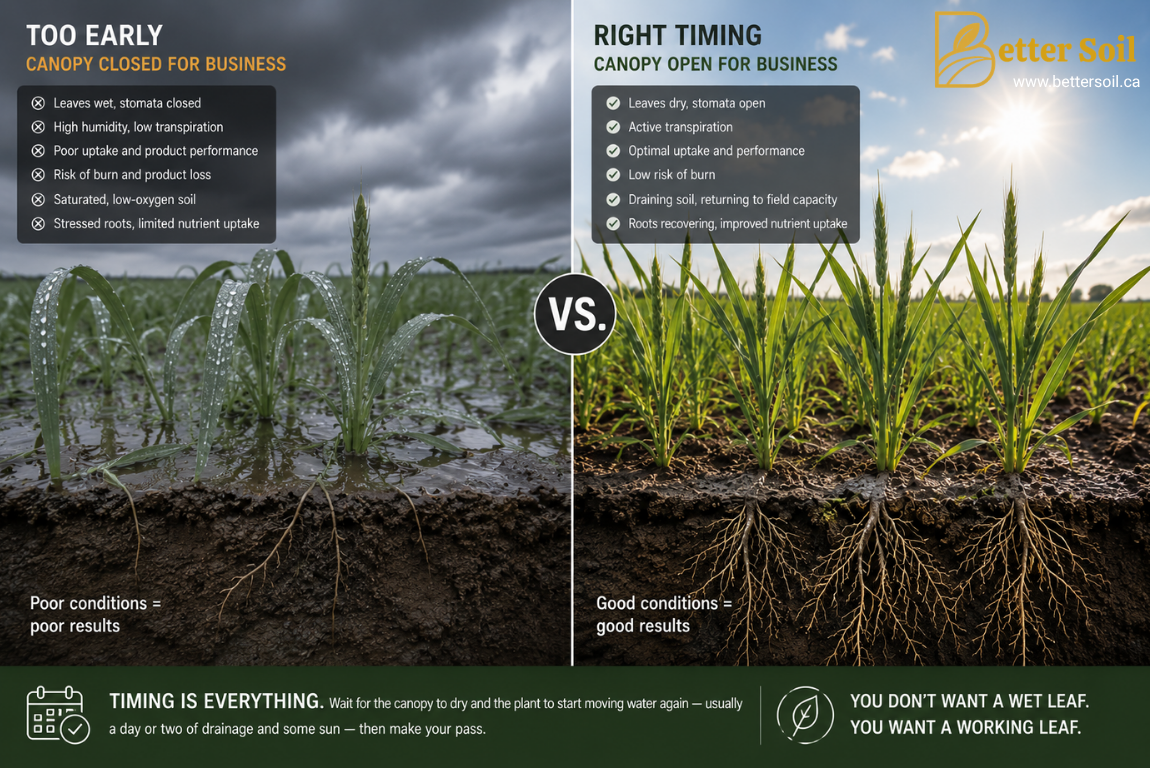
Foliar uptake runs on transpiration — and a wet, stressed canopy isn't transpiring well. This is the cruel irony: under drought or salt stress, foliar applications failed to help precisely because the stress has shut down transpiration and slowed uptake of K, Ca, Mg, and P. The same caution applies right after saturating rain when humidity is high, the canopy is wet, and the plant is stressed. If you spray into a soaked sluggish canopy, much of your product evaporates or sits there undelivered.
The practical takeaway: don't spray during the wet, anaerobic crisis. Wait for the canopy to dry and the plant to start moving water again — usually a day or two of drainage and some sun — then make your pass. You want the leaf open for business.
Other things to consider are leaf burn and short contact time. High salt concentrations scorch tissue, and a droplet that dries in two minutes never gets absorbed. Rate, water volume, humidity, time of day, and a quality adjuvant all matter more than the label suggests.
However, the tension between getting enough nutrient on the leaf and not burning it, between coverage and contact time — is exactly where formulation technology has moved the goalposts in the last few years. A conventional foliar is fighting physics: the nutrient is carried as a relatively coarse salt or particle that sits on a waxy cuticle, dries down fast, and has to be loaded heavily enough to drive uptake before it crystallizes off. Crank the rate to get more in, and you risk the burn.
Newer particle-scale technologies attack that trade-off directly. By shrinking the nutrient to a far smaller particle — in some formulations down toward the molecular scale — these products are built to spread across and penetrate the leaf surface far more readily than a conventional salt, and to be absorbed and used quickly rather than drying off the leaf. The practical advantages stack up in a useful direction: meaningful nutrition delivered at very, very low rates, almost eliminating burn-risk, better coverage and contact, and faster bioavailability once the nutrient is in.
It's worth being clear about what this does and doesn't change. These technologies improve *delivery* — how much nutrient crosses the leaf surface, how gently, and how fast. They don't rewrite the plant's internal plumbing: a poorly phloem-mobile nutrient like calcium still won't redistribute far from where it lands, no matter how well it penetrates, so placement and timing on the right tissue still matter. Better delivery is a genuine step forward, not a free pass on the agronomy. And as with everything else in this piece, the honest test is a check strip on your own ground — the gains are real, but the size of them depends on your crop, your soils, and your water, so prove it where you farm.
Let's talk Humic
Making your UAN go further
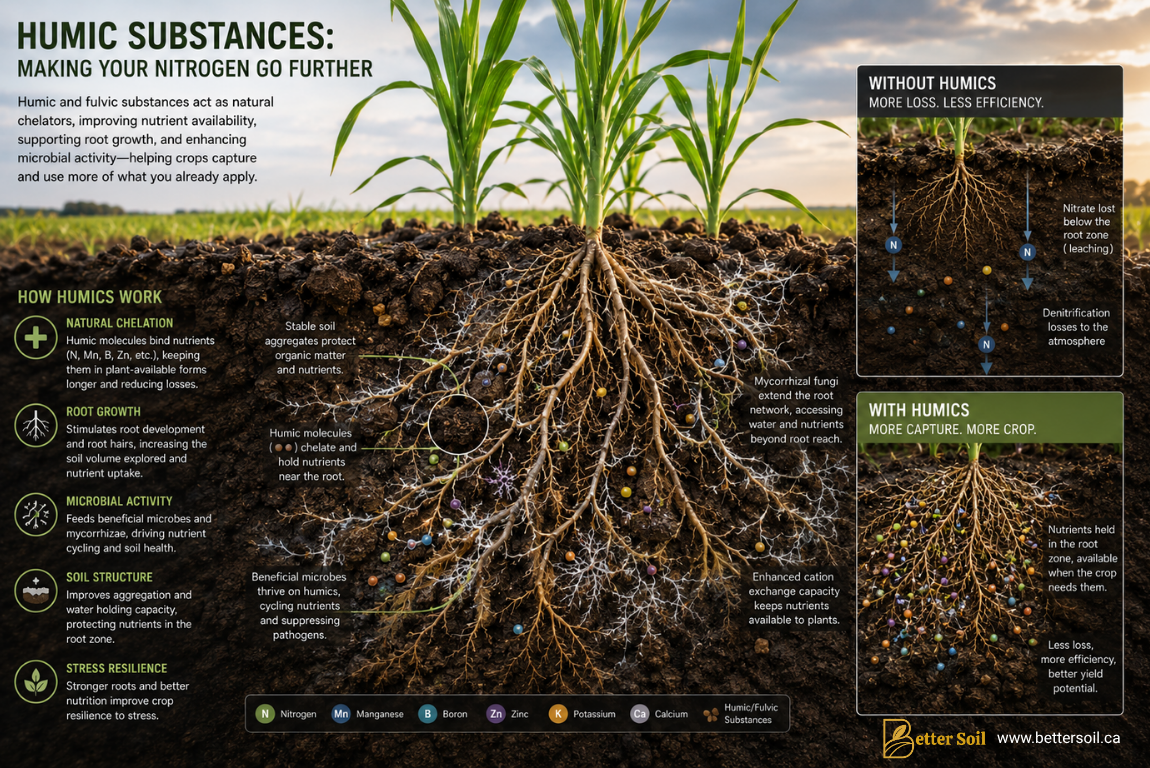
Humic and fulvic substances act as natural chelators. The Niu et al. (2020) lists humic acid among the main chelating agents that "enhance crop stress resistance, promote the growth of crop roots, and improve the ability of crops to absorb nutrients." In their data, leaves fed humic acid alongside a manganese-boron mix took up meaningfully more of both micronutrients than the same mix without the humic carbon. The general principle from the chelation literature is consistent: pairing a nutrient with the right organic carbon compound improves how much of it the plant captures and uses, rather than how much you applied.
For those of you out there that plan on applying UAN through a pivot, the appeal is efficiency. A portion of UAN — the urea fraction — is vulnerable to volatilization and, once nitrified, to the leaching and denitrification losses we just discussed. Carrying it with humic/fulvic carbon gives the soil and crop a food source right where the nitrogen lands, supports the microbial cycling that stabilizes N, and (the chelation angle) keeps companion cations and micronutrients more available. The mechanism is well supported, but field yield responses to humic's have been variable with the biggest differences on degraded, low-organic-matter, high-pH, or structurally poor soils and the smallest result typically on already-healthy ground.
Untying locked-up nutrients in high-Ca and sodic soils
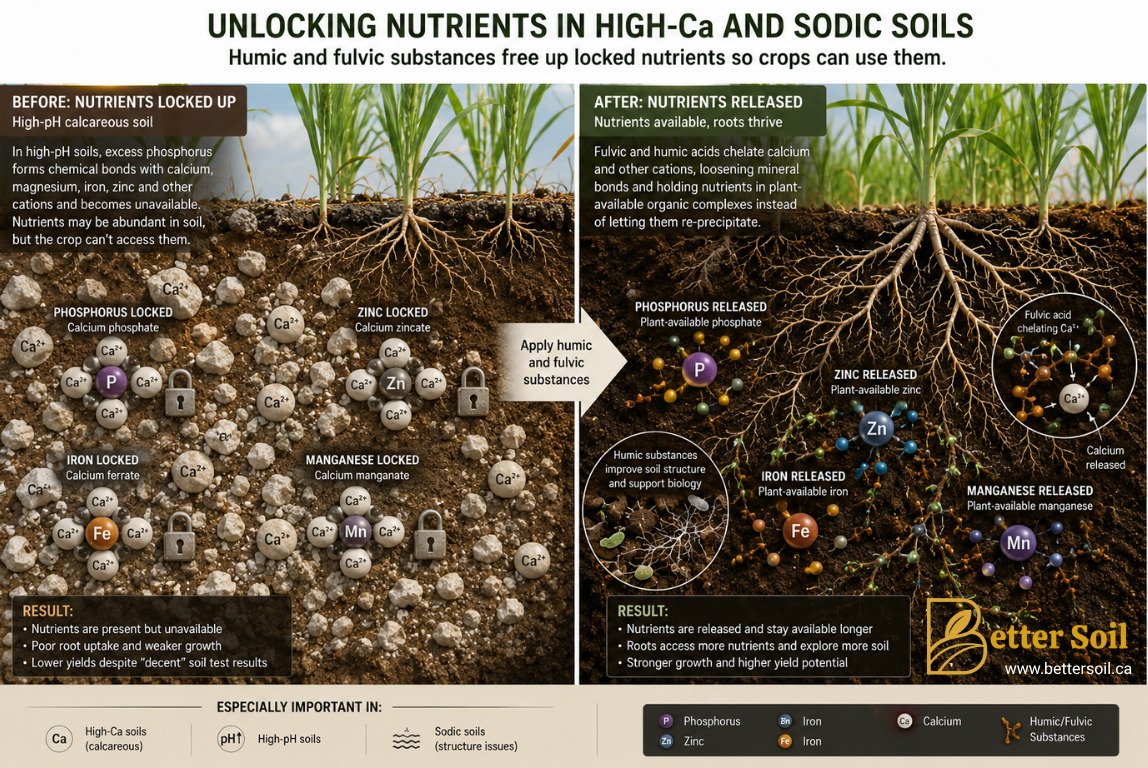
This is where the soil chemistry gets satisfying. In high-pH calcareous soils, phosphorus doesn't disappear — it gets fixed. Excess phosphorus forms chemical bonds with calcium, magnesium, iron, and zinc and becomes unavailable, so that "although nutrients may be abundant in soil, low bioavailability will restrict plant growth." You can have a soil test showing decent P and a crop that can't touch it because it's tied up as calcium phosphate.
Humic and especially fulvic acids work on this by chelating the calcium and other cations, loosening those mineral bonds, and holding P and micronutrients (Fe, Zn, Mn, Cu) in plant-available organic complexes instead of letting them re-precipitate. Fulvic acid is the smaller, more soluble, lower-pH-stable fraction — usually the better choice for foliar and fertigation work and for mobilizing tied-up nutrients. Humic acid is the larger fraction, better at the longer-term soil-conditioning and cation-exchange and structure work.
In sodic soils — high exchangeable sodium, dispersed clay, poor structure, crusting, water that won't infiltrate — the structural problem compounds the chemical one. Humic substances help here partly through the chemistry and partly by supporting aggregation and biology over time. However, the real fix for sodicity is displacing sodium (calcium source plus leaching where drainage allows), and humic's are a complement to that, not a replacement for it.
Be ready before the next big rain
Build the program assuming a wet year is coming. Front-loading 100% of your N at seeding is the highest-risk strategy in a wet year. Build in splits — pre-plant base, in-season top-up via UAN through the pivot or sprayer, and foliar passes guided by tissue testing. Sitthaphanit's data is clear: 3-5 splits cut leaching to near-zero and lifted yields meaningfully over a single basal dose. The same logic protects you against denitrification — fertilizer that's still in the bin can't be denitrified. Reserve 30-50% of your N for in-season application and you've insulated a big share of your program from any one weather event.
Pre-stage your foliar program. Have your nutrients, humic/fulvic carrier, biostimulants, and adjuvants on the shelf with a written mix recipe and a jar-tested compatibility check already done. When the canopy dries and the plant start transpiring again, you want to be in the sprayer that same day — not chasing down product or waiting on a delivery.
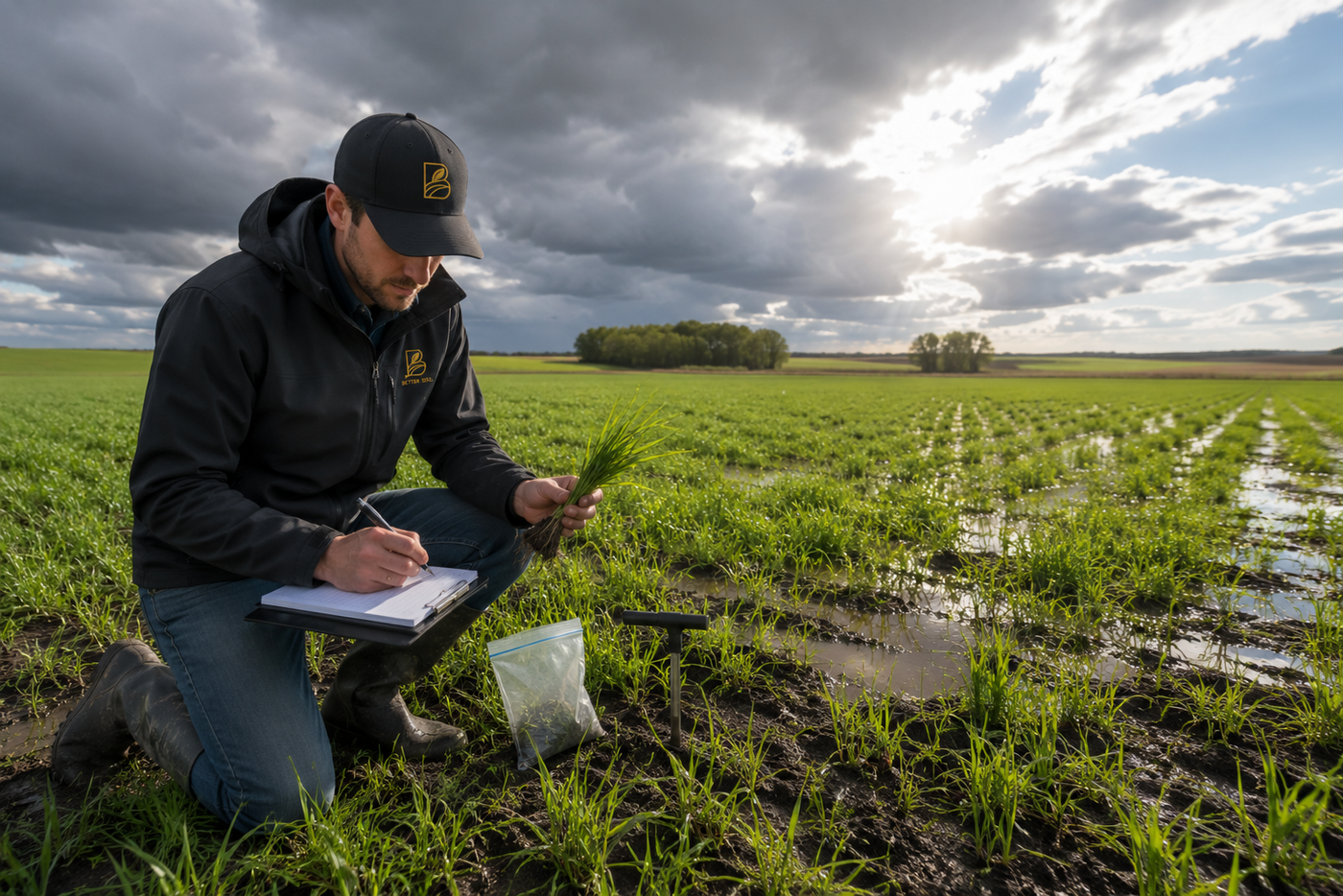
Have a tissue or sap testing protocol ready and a lab on speed-dial. A test taken in that day-3-to-4 window, before symptoms appear, tells you exactly what to put in the tank. Reacting to visible deficiency means you're already a week behind it.
Know your saturation-prone fields. Every grower knows which quarters and which low spots hold water — write them down. Those are the first fields to scout, tissue-test, and treat after a big rain, and the ones that benefit most from drainage investment, residue management, and a long-term organic-matter program.
While you're waiting for the soil to drain — do nothing on the soil. Don't drive on saturated ground (sidewall compaction undoes years of structure work in one pass), don't fertigate UAN into a saturated profile (you'll just feed the denitrifiers), and don't broadcast granular onto a sluggish, anaerobic field expecting it to fix anything. Use the waiting time to scout and plan.
When the canopy dries and the plant move water again, go. That's usually 24-48 hours of drainage and some sun after the saturation lifts. The foliar pass — N and sulfur to replace what was denitrified and leached, plus the micros your tissue test flagged, carried with humic or fulvic acid to support the recovery biology — is the single most impactful agronomic action you can take in that window. It gets nutrition into the plant immediately, feeds the recovering root system, and primes the crop to use what's still in the soil more efficiently.
The bottom line

A heavy rain changes the rules. The growers who respond fastest usually keep the most yield.
A heavy rain doesn't just wet your field — it relocates your fertilizer, drowns your roots, and throws off the crop's nutrient timing right when demand is climbing. Foliar feeding is the tool that lets you take that timing back: it delivers nutrition through the leaf when the soil pathway is compromised, helps recovering roots get back to work, and makes the crop more efficient at using whatever fertilizer is still in the ground. It won't replace your bulk program, it won't move calcium where calcium won't go, and it won't help if you spray a stressed, soaking-wet canopy — so respect the limits.
And on the high-calcium, sodic soils where so much fertility sits locked and unavailable, humic and fulvic acids are a genuinely useful partner for your UAN, improving efficiency, chelating tied-up phosphorus and micronutrients into a form the crop can use, and supporting the soil biology that holds the whole system together.
Remember, jar-test before you tank-mix, time it around the rain rather than into it, and leave a check strip to prove it on your own ground.
Sources behind this piece:
Niu, Liu, Huang, Liu & Yan (2020), "Effects of Foliar Fertilization: a Review of Current Status and Future Perspectives," Journal of Soil Science and Plant Nutrition; and Sitthaphanit, Limpinuntana, Toomsan, Panchaban & Bell (2009), "Fertiliser strategies for improved nutrient use efficiency on sandy soils in high rainfall regimes," Nutrient Cycling in Agroecosystems. Leaching figures are from sandy tropical soils and illustrate principles rather than transferable rates for heavier calcareous soils. Safeguard Nutrients in heavy Rain: sund.ag/blog/safeguard-nutrition-in-heavy-rain. Nitrogen losses after the heavy rains, John Sawyer (2004), Iowa State Univeristy.
Not Sure What This Rain Did To Your Crop?
Every field responds differently.
The amount of nitrogen lost, the severity of root stress, and the best recovery strategy depend on:
- Soil type
- Crop stage
- Fertility program
- Drainage
- How long the field remained saturated
A sandy field near Vauxhall may be dealing with nutrient loss.
A heavy clay field near Vulcan may be dealing with oxygen loss.
The solution isn't always the same.
If you're wondering whether a foliar pass, tissue test, SAP analysis, or nitrogen top-up makes sense on your acres, let's look at it together.
Book your acres for scouting or just give me a call.
What you'll get:
✓ Independent recommendations
✓ Practical recovery options
✓ Field-specific guidance
✓ No product sales pitch
Free Download
Post-Rain Emergence Field Checklist
A free printable field worksheet to help assess stand counts, emergence uniformity, crusting, physical and brix assessment, pest pressure and replant decisions after heavy rain.
- Plant population
- Emergence uniformity
- Surface crusting
- Physical & BRIX assessment
- Missing plants & gaps
- Pest pressure
- Root & seedling health
- Nutrient Assessment


We respect your privacy. No spam. We will only send you what you asked for.

Foliar Strategy Call
Ready to make an informed decision from your SAP Analysis?
Book a free 30-minute Foliar Strategy Call and get a clearer read on what your crop actually needs.
Book Your Scouting